What is Affiliate Tracking? A Beginner’s Guide to Getting Started (2026)

Affiliate marketing is a powerful business strategy for expanding reach and driving sales. However, to effectively manage and optimize your affiliate program, you need to understand the fundamentals of affiliate tracking.
Affiliate tracking is crucial to running a successful affiliate program, making all your hard work count, and ensuring your affiliates get paid. It allows you to effectively monitor and optimize your affiliate campaigns based on accurate real-time data so you can reach your target audience. That’s right, there’s no room for guessing or assumptions! But how do you do that?
Metrics, optimization, affiliate management, and figuring out your affiliate marketing strategy are no easy feat, so we’re here to help.
In this comprehensive guide, we will explain affiliate tracking and its importance. You’ll gain some insight into how to get started. We’ll also break down the process of setting up and using affiliate tracking with Partnero as an example so that you can maximize your affiliate program's performance across your affiliate networks.
What is Affiliate Tracking?
Affiliate tracking, or affiliate conversion tracking, is the process of monitoring and attributing conversions or actions generated by affiliates. Conversion matters. It tells you what works and what doesn't for all affiliate types. It’s the center of your entire program, strategy, and affiliate universe. It’s how your affiliate partners get paid (fairly)! Simple, isn’t it?
By assigning unique tracking codes or tracking links across your marketing channels, businesses can measure the success of their affiliate program by tracking their affiliates’ performance and affiliate sales. After all, affiliate commissions are performance-based.
Most businesses also automate the whole affiliate tracking process. Tracking affiliates manually, like generating tracking codes or affiliates, is challenging, so using affiliate tracking software, a partnership management platform, or a site add-on is usually done.
This encourages transparency and accountability in a partnership. Affiliate tracking is the basic foundation and backbone of a win-win partnership.
Why is Affiliate Tracking Important?
We’ve talked about what affiliate tracking is and touched a bit on why it’s important. Here’s more, and they’re linked to transparency and accountability. Accurate tracking is crucial for several reasons:
1. Performance Measurement
We’ve harped on this, but it is important! Tracking enables you to measure the effectiveness of your affiliates, identify top performers, and optimize your program accordingly.
2. Commission Attribution
Tracking ensures affiliates receive the right credit for the conversions they generate, allowing you to calculate and distribute affiliate commissions accurately, especially if you already have commission rates in place.
3. ROI Analysis
By tracking conversions and revenue, you can calculate your affiliate program's return on investment (ROI) and make data-driven decisions to save time and resources.
4. Fraud Prevention
Tracking helps detect fraudulent activities, such as cookie stuffing or click fraud, protecting your program from potential losses.
5. Boosts Partnership Management Productivity
Tracking conversions and revenue helps you manage your affiliate better. This can boost productivity within your team and your affiliate network.
6. Provides Insights
Affiliate tracking provides insights into how your overall marketing campaigns and strategy are going. You can dive deep into the data for not only your affiliate program but also other areas of marketing, such as SEO and more.
What Affiliate Tracking Methods Are Available?
There are various affiliate tracking methods out there. While they track conversion rates, what works depends on your partnerships. Here are some affiliate tracking methods to consider:
1. Manual Tracking
The traditional method of tracking referrals, sales, and partner commissions in the affiliate marketing industry relies on labor-intensive manual analysis and data correlation from various sources. Examples include ecommerce sites and Google Analytics.
While manual tracking is great for directly allocating sales to affiliates without automated tracking software, it has its drawbacks, such as:
- Human Error: Mishandled data and improper attribution can lead to inaccurate commission payments. This strains your partnerships and could prevent you from attracting the best affiliates.
- Prolonged Process: Whenever a sale occurs, the affiliate's unique code or link must be manually compared to the transaction recorded by the e-commerce platform. This often requires cross-referencing data from the transaction platform and tracking data from the affiliate's actions.
When you automate this process, you save time and are less likely to make mistakes.
2. Cookie Tracking
Cookies, such as first-party cookies and third-party cookies (being phased out), are small data stored in a user's browser when they visit a website. Tracking cookies require the user's consent to be used. When the user browses the website, the cookies enable the website to recognize and track their online behavior, even beyond the website.
In affiliate tracking, cookies store information when a user clicks on an affiliate link. These cookies can contain various data about the user, such as the time and date of the click and the website they visited. The lifespan of these cookies differs, depending on your tracking capabilities. Affiliate tracking cookies typically have a lifespan of 30 days. However, some programs, like Amazon Associates, may extend the cookie lifespan to 90 days, still attributing the sale to the affiliate.
However, the drawbacks include:
- Additional Work: Affiliates must accept and activate cookie tracking to be effective. Affiliates may also delete the cookies before purchase, which means any tracking is lost, and the affiliate won't receive any commission for the sale.
- Browser-Dependent: Cookies are browser-dependent and do not track across devices. If a customer uses multiple browsers or devices during their buying journey, tracking them accurately can be challenging.
Cookies play a significant role in affiliate tracking, but they have limitations, which can impact the accuracy of affiliate attribution.
3. Pixel Tracking
Pixel tracking is another valuable solution for determining different traffic channels' effectiveness. By embedding a small code snippet, known as a pixel, on specific pages, you can track the performance of your affiliate links. Once the pixel is loaded, you can track user activity on your pages. If the user clicks on your affiliate links, you can attribute their visit to your affiliates.
Pixel tracking provides valuable insights into traffic sources or types of affiliates driving the highest-quality traffic to your affiliate links. What are the drawbacks?
- Complicated Setup: Pixel tracking can be more complicated if you don’t have web development or coding knowledge. Although you don’t have to be a developer, it may take time to learn how to embed a snippet into the backend of your pages.
- Inaccurate Tracking on Mobile Devices: Pixel tracking may face challenges in accurately tracking conversions on mobile devices, especially in cases where cookies are not supported or are restricted.
- Limited Attribution Models: Pixel tracking typically relies on last-click attribution, which attributes conversions to the last interaction before the conversion. This may not provide a comprehensive view of the customer journey and may not accurately reflect the impact of other marketing channels.
By understanding the performance of different channels, you can optimize your marketing efforts and make informed decisions about where to allocate your resources.
4. API Tracking
API tracking uses an Application Programming Interface (API) to track and monitor affiliate marketing activities. This enables affiliates and advertisers to integrate their systems and exchange data in real time, enabling accurate tracking of clicks, conversions, and commissions. Based on these reports, you can make more precise data-driven decisions.
API tracking provides a more seamless and efficient way to manage affiliate campaigns, automate processes, and ensure accurate reporting and payouts. It becomes one with your tech stack. This can also scale with your program and business. However, here are some drawbacks:
- Integration limitations: API tracking relies on the compatibility and availability of APIs between affiliate platforms and advertiser systems. Incompatibility or limited API support can hinder seamless integration.
- Potential for downtime: If the API service experiences downtime or disruptions, it can temporarily impact tracking and reporting capabilities, affecting the accuracy and timeliness of data.
5. Server-To-Server Tracking (aka Postback URL Tracking)
People tend to mix these up, but Server-to-Server (S2S) tracking differs from cookie tracking. S2S tracking isn’t browser-dependent and doesn’t store information in browsers at all. Instead, the data is stored on the tracking servers of the affiliate network and advertising networks such as Google or Facebook. When a user clicks on an affiliate link and completes a conversion, they are assigned a unique ID.
Once the affiliate network assigns the user a unique ID, it returns the data to the advertiser. The advertiser's tracking system then searches for the matching unique ID. Once the match is found, the advertiser and the network can confirm that your click resulted in a sale, and you can issue your top affiliates their commission.
S2S has a reputation for being a safe and more trustworthy affiliate tracking method that complies with privacy laws. But no method is perfect. Here are some drawbacks:
- Compatibility Challenges: S2S tracking may face compatibility issues with certain platforms or technologies. It may not be compatible with all tracking systems or require additional integration efforts.
- Limited Customization Options: S2S tracking may have limitations in terms of attribution models and tracking capabilities. It may not support advanced attribution models like multi-touch attribution or cross-device tracking.
- Potential Data Loss: In some cases, data loss can occur between the affiliate network and the advertiser's server during the data exchange. This can result in incomplete or inaccurate tracking data.
- Implementation Complexity: S2S tracking requires technical expertise and development resources to set up and maintain the server-side scripts and API integrations, making implementation more complex than client-side tracking methods.
S2S tracking removes cookie reliance and ensures that the attribution process is based on the unique ID assigned to the user. This provides a reliable and accurate way to attribute commissions.
6. Other Affiliate Tracking Methods
A few other outdated tracking methods are worth mentioning, but we won’t dive too deep into them. These affiliate tracking methods include:
- Third-Party Cookies: Third-party cookies are small text files set by third-party domains that track user behavior across different websites for various purposes, such as advertising, analytics, and personalization. They have raised privacy concerns because they can track user behavior without consent. These don’t meet compliance standards, so they are being phased out.
- Consent-Less Tracking: Users may unknowingly agree to some tracking when purchasing an affiliate offer. When a user makes a purchase, they still provide valuable information. During the checkout process, users actively agree to the terms and conditions of the e-commerce store, which can be seen as a form of new consent.
- Impression Tracking: Tracks users who see your ads or landing pages but don’t convert. This is a great way to see if your SEO is working.
- Lifetime Commissions: Tracks data linked to affiliate links and follows the user across devices and locations. From the affiliate link or search engine to conversion. You can see it all.
- Action Tracking: Tracks user reactions and behavior after they see your ads or landing pages. This helps you get to know your potential customers better.
- Per Product Tracking: Track each product separately to avoid commission mix-ups. This might be useful if you’re a product marketer or considering investing in product marketing.
- Offline Tracking: Many influencers promote products on social media through coupons. Although more manual, sometimes this is the only option.
*Partnero offers first-party cookies, API (now available), and S2S tracking (coming soon)!
How Does Affiliate Tracking Work? Getting Started with Affiliate Tracking
1. Choose an Affiliate Tracking Platform
Select a reliable affiliate tracking platform like Partnero, which offers robust tracking capabilities and user-friendly features.
2. Set Up Your Affiliate Program
Define your program's goals, commission structure, and terms. Then, log into your affiliate tracking software or partnership management platform of choice. Set up your program and create an application process for potential affiliates to join your program.
Here’s how it’s done on Partnero:
- Create and customize an affiliate program
- Create an advanced commission structure
- Design a partner portal
3. Generate Tracking Links or Codes
Your tracking platform should automatically set up unique tracking links or codes for each affiliate. These links will track their referrals.
You can manage and create additional advanced links on Partnero.
4. Implement Tracking on Your Website
Usually, there are three parts to integrating an affiliate program into your website and app:
- Tracking referral visits: This is usually done by implementing a tracking script on your website. The script informs your affiliate management platform whenever someone visits your website through a referral link.
- Tracking referral signups: this is normally done through an API call or an additional script. When a referred visitor creates an account on your website, this step initiates creating the referred customer on your affiliate management platform.
- Tracking referral purchases: usually done through native 3rd party integrations (such as Stripe) or API calls. This step sends data between your e-commerce solution and your affiliate management platform whenever a transaction happens.
Additional resources:
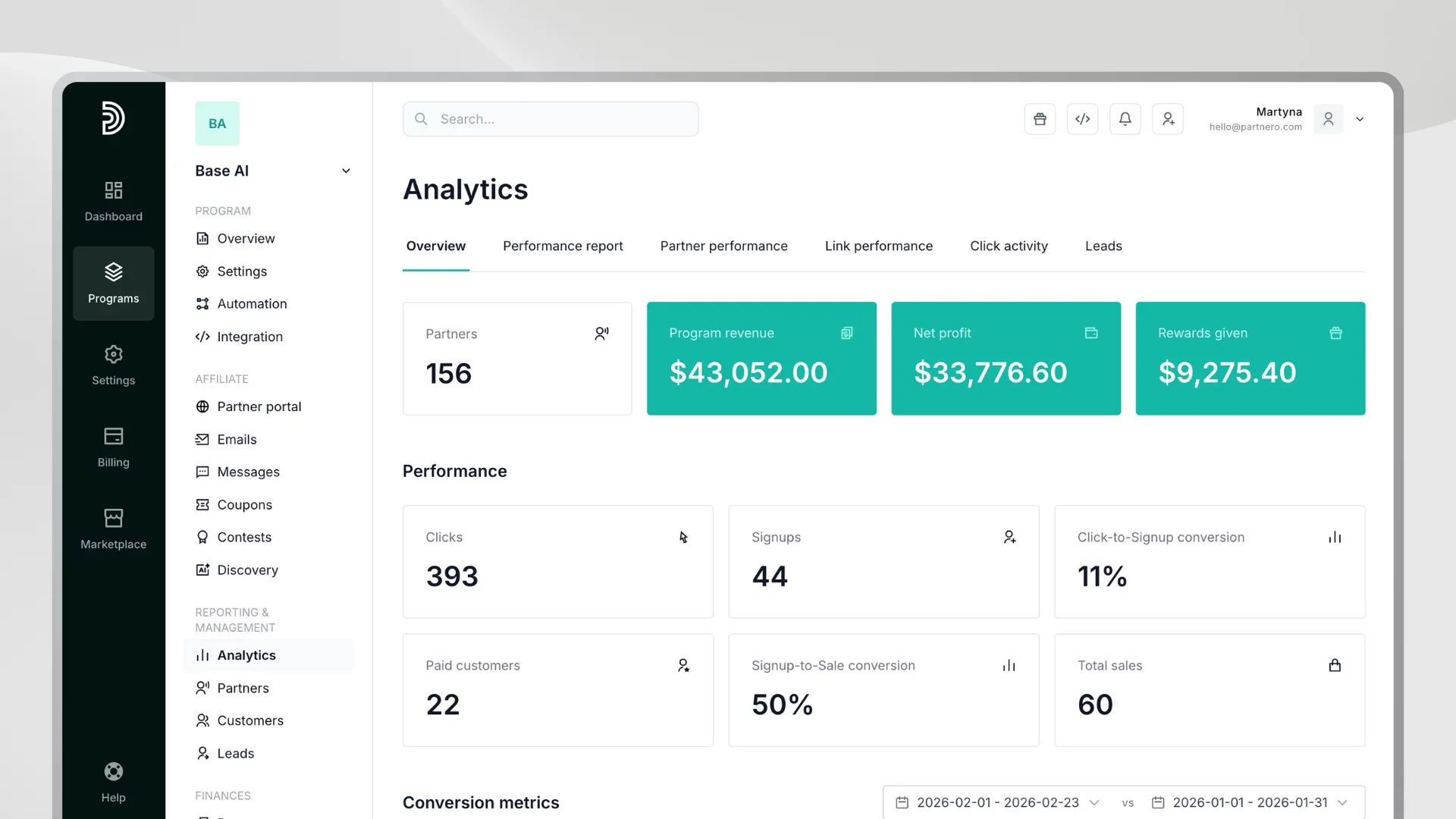
5. Monitor and Analyze Performance and KPIs
Regularly review your tracking reports to assess affiliate performance, track conversions, and identify areas for improvement. Here are some KPIs to keep track of:
- Conversion rate
- Click traffic
- Earnings per click (EPC)
- Number of sales
- Total revenue
- Number of affiliates
- Percentage of new customers
- Average order value (AOV)
- Cost per affiliate or sale
You can use Partnero’s Analytics to do this:
6. Optimize Your Program
Use the insights gained from tracking data to optimize your program. Adjust commission structures, provide affiliates with better resources, and foster stronger relationships with top performers.
What is Affiliate Tracking Software?
Affiliate tracking software is a tool that enables businesses to track and manage their affiliate marketing programs. It provides a platform for businesses to create unique tracking links for their affiliates.
Affiliates promote products or services and earn performance-based commissions for each successful referral or sale, especially in SaaS or e-commerce. The software tracks each affiliate's performance, including clicks, conversions, and revenue generated, providing valuable insights for businesses to optimize their affiliate marketing efforts.
Affiliate tracking software often includes payout management, reporting, and analytics features to help businesses manage and scale their affiliate programs effectively. By monitoring the traffic generated by bloggers, influencers, and other affiliates, businesses can determine the impact of their partnerships on their overall success.
What Are the Most Important Affiliate Tracking Software Features?
When choosing an affiliate tracking software, here are some important aspects to look for:
- Tracking Accuracy and Options: Accurate tracking options for affiliate referrals, conversions, and commissions are important. It should be able to track various types of conversions, such as sales, leads, or app installs, and attribute them to the correct affiliates.
- Reliability and Stability: Ensure tracking data is consistently recorded and accurately reported. Look for a robust infrastructure to handle high traffic volumes without downtime or performance issues.
- Customization and Flexibility: Customize tracking parameters, commission structures, and affiliate program rules to suit your business needs. Look for flexibility in setting up different commission models, tracking methods, and payout options.
- Multi-Channel Tracking: Consider whether the software supports tracking across multiple channels, such as websites, mobile apps, social media, or email campaigns. This is important if you have diverse marketing channels and want to track affiliate performance across all of them.
- Real-Time Reporting: Comprehensive reporting and analytics features help you monitor affiliate performance, track conversions, and analyze campaign effectiveness. Look for features like real-time reporting, conversion tracking, affiliate dashboards, and performance metrics.
- Affiliate Management Tools: Good affiliate tracking software offers tools for managing your affiliate program effectively. These may include features like affiliate recruitment, onboarding, communication, and performance monitoring. Simplify affiliate management tasks.
- Integration Capabilities: Consider whether the software integrates with other tools and platforms you use, such as e-commerce platforms, payment gateways, email marketing software, or CRM systems. Streamline workflows and data exchange between different systems to make your life easier.
- Security and Compliance: Ensure the software prioritizes data security and compliance with privacy regulations. Look for features like secure data transmission, encryption, GDPR compliance, and options for user consent management.
- Customer Support: Evaluate the level of customer support the software vendor provides. Look for responsive customer support, comprehensive documentation, and resources like tutorials or knowledge bases to help you set up and use the software effectively.
- Pricing and Scalability: Consider the software's pricing structure and whether it aligns with your budget and expected growth. Look for software that can scale with your business as your affiliate program expands.
5 Best Practices for Affiliate Tracking
We’ve gone through quite a bit now! Before we wrap up, here are some best practices to follow so you hit affiliate tracking on the nail.
1. Promote Transparency
Communicate your tracking methods and commission structure to affiliates, fostering trust and transparency.
2. Regularly Test Tracking Links
Test your tracking links to ensure they function correctly and accurately attribute conversions.
3. Stay Compliant with Regulations
Adhere to privacy regulations, such as the General Data Protection Regulation (GDPR), by obtaining consent and protecting user data.
4. Provide or Talk to Affiliate Support
If you’re a vendor, offer prompt support to affiliates, addressing any tracking-related issues or questions they may have. If you’re a user, make sure you have regular conversations with the vendor to address any issues and keep up to date with regulations!
5. Stay Updated on Industry Trends
Keep abreast of the latest developments in affiliate tracking, including new technologies and best practices.
Partnero: Affiliate Tracking Done Right
Affiliate tracking is the backbone of a successful affiliate marketing program. Understanding the basics of affiliate tracking can help you build strong partnerships with affiliates. With the knowledge gained from this beginner's guide, you are well-equipped to embark on your affiliate tracking journey and take your affiliate marketing efforts to the next level.
Looking for a reliable tracking platform? Partnero’s partnership management platform makes it easy to accurately track all your affiliate links across the internet and devices, whether you’re a beginner or an affiliate-tracking expert.
Get to know Partnero first-hand by signing up for a free trial. Your first month is on us!
Launch your program in minutes or get in touch for advanced setups.
Fast setup & easy migration
Connect Partnero to your tools, with support if you’re switching platforms.Automated, transparent payouts
Pay partners on schedule and save hours. No spreadsheets or manual errors.
Affiliate and referral program software trusted by 3,000+ businesses. Connect with Stripe, Paddle, Shopify and more.


Product updates, affiliate marketing tips, and growth insights.